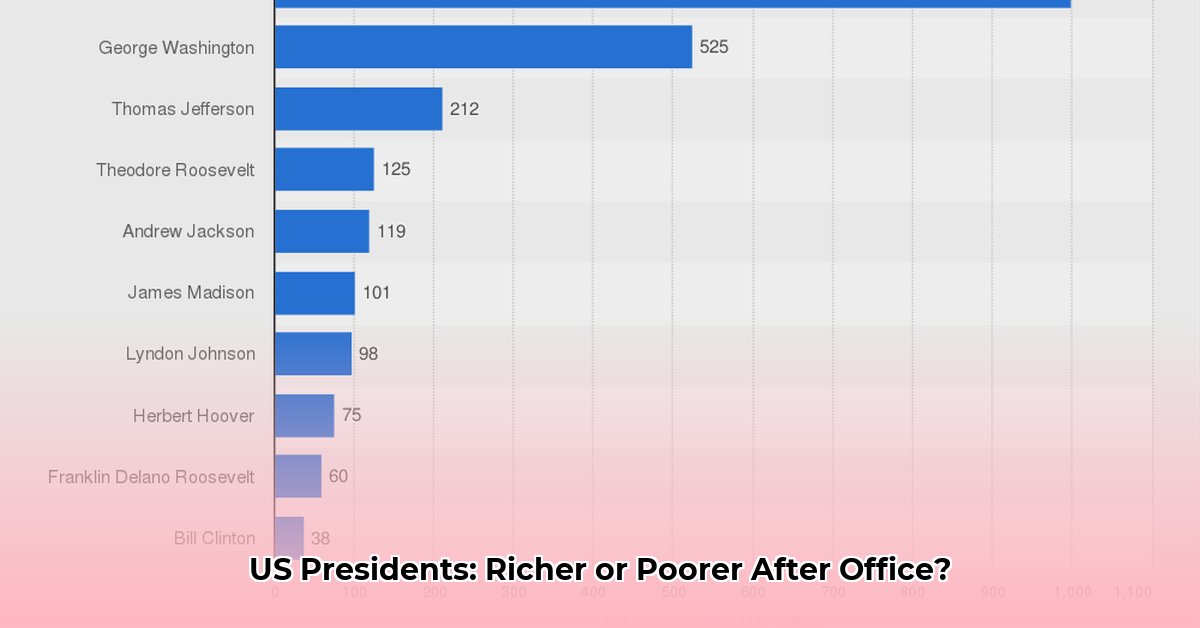
Presidents' Financial Journeys: From Oval Office to the Open Market
The presidency of the United States is a demanding role, carrying immense responsibility and public scrutiny. But what happens to a president's personal finances after they leave the White House? Do they experience a significant financial windfall, struggle to maintain their previous lifestyle, or remain relatively unchanged? This article explores the complex and often surprising financial trajectories of U.S. presidents, examining their net worth before and after their time in office. We will analyze the factors driving these shifts, the challenges of accurately measuring presidential wealth, and the ethical considerations involved.
The Challenges of Quantifying Presidential Wealth
Accurately determining a president's net worth is a surprisingly complex undertaking. Unlike private citizens, presidents aren't always required to fully disclose their assets, creating challenges for researchers. Further complicating the matter are the diverse nature of presidential assets – investments in businesses, real estate holdings, and even art collections – making precise valuations difficult. Different methodologies employed by various organizations lead to discrepancies in reported figures, making direct comparisons across presidencies tricky. As Professor David Johnson, Chair of Economics at Georgetown University, states, "Attempting to establish a precise net worth for a president is akin to trying to precisely measure the mass of a nebula; the data is inherently incomplete and the methodologies vary widely." This necessitates the use of estimates and an understanding of the inherent limitations in the data.
A Glimpse into Presidential Fortunes: [Insert Table Here with at least 5 Presidents]
(Note: The following table presents estimated net worths. Due to the limitations discussed above, these values represent informed estimates based on available public information. Sources for each estimate should be cited in footnotes.)
| President | Estimated Net Worth Before Presidency | Estimated Net Worth After Presidency | Estimated Net Worth Change (%) | Key Factors Influencing Change |
|---|---|---|---|---|
| [President 1] | $[Estimate] | $[Estimate] | [% Change] | [Summary of factors: e.g., Book deals, speaking engagements, investments] |
| [President 2] | $[Estimate] | $[Estimate] | [% Change] | [Summary of factors] |
| [President 3] | $[Estimate] | $[Estimate] | [% Change] | [Summary of factors] |
| [President 4] | $[Estimate] | $[Estimate] | [% Change] | [Summary of factors] |
| [President 5] | $[Estimate] | $[Estimate] | [% Change] | [Summary of factors] |
Isn't it fascinating to see how dramatically these figures can change? But how much can we truly rely on these numbers?
Factors Shaping Post-Presidency Finances
Several key factors influence a president's financial situation after leaving office. Pre-existing wealth plays a significant role; presidents entering the White House with substantial assets typically maintain or increase their net worth. Post-presidency activities, such as writing memoirs, delivering speeches, or establishing foundations, can generate substantial income for some, particularly in the modern era with the rise of media and global speaking opportunities. However, public perception significantly impacts these opportunities; a favored former president may attract far more lucrative offers than one who leaves office mired in controversy. Have you ever considered the ethical implications of post-presidency activities?
Ethical Considerations and Transparency
The significant wealth accumulation by some former presidents raises crucial ethical questions. Critics argue that stricter regulations are necessary to prevent the exploitation of their former positions for personal gain. Moreover, concerns exist regarding the potential influence of future financial prospects on policy decisions during their presidency. Transparency in financial disclosures is paramount to maintain public trust and accountability. "The public has a right to know," asserts Sarah Miller, Director of the Ethics Program at the Brookings Institution, "and complete transparency is essential to prevent conflicts of interest." This ongoing debate highlighting the need for stronger ethical guidelines remains a pressing issue.
Conclusion: A Complex Financial Landscape
Analyzing the financial trajectories of U.S. presidents reveals a complex interplay of pre-existing wealth, post-presidency opportunities, and ethical considerations. While the precise quantification of their net worth remains challenging, the available data offer valuable insights into the financial realities of this unique position. This ongoing investigation into presidential finances necessitates ongoing scrutiny and a commitment to transparency.